Research snapshot: October 25, 2026, 11:36 PM EDT. Adapted into this archival white paper on October 29, 2026. These are results from the original computer configuration, before the later GPU and RAM upgrade.
Open the original interactive clip-review gallery · Five-second results · Ten-second results · Download all 43 entries
What this experiment was trying to answer
Before investing in a larger workstation, I wanted to know what my existing author computer could do with local video models. Could it make usable short performances from a reference image? How long did I have to wait? What happened when I asked for more resolution or a longer clip?
This paper preserves the review snapshot behind the original Author Video Lab gallery. It follows the October 24 H3 study and precedes the upgraded-computer comparison. The gallery lets readers inspect the pictures alongside their timings, rather than treating speed as proof of quality.
The computer and the scope
The original setup had an NVIDIA RTX 5070 with 12 GB of VRAM and 32 GB of system RAM. The gallery’s delivery clips are silent and run at 24 fps. Original generated audio remains in the research archive.
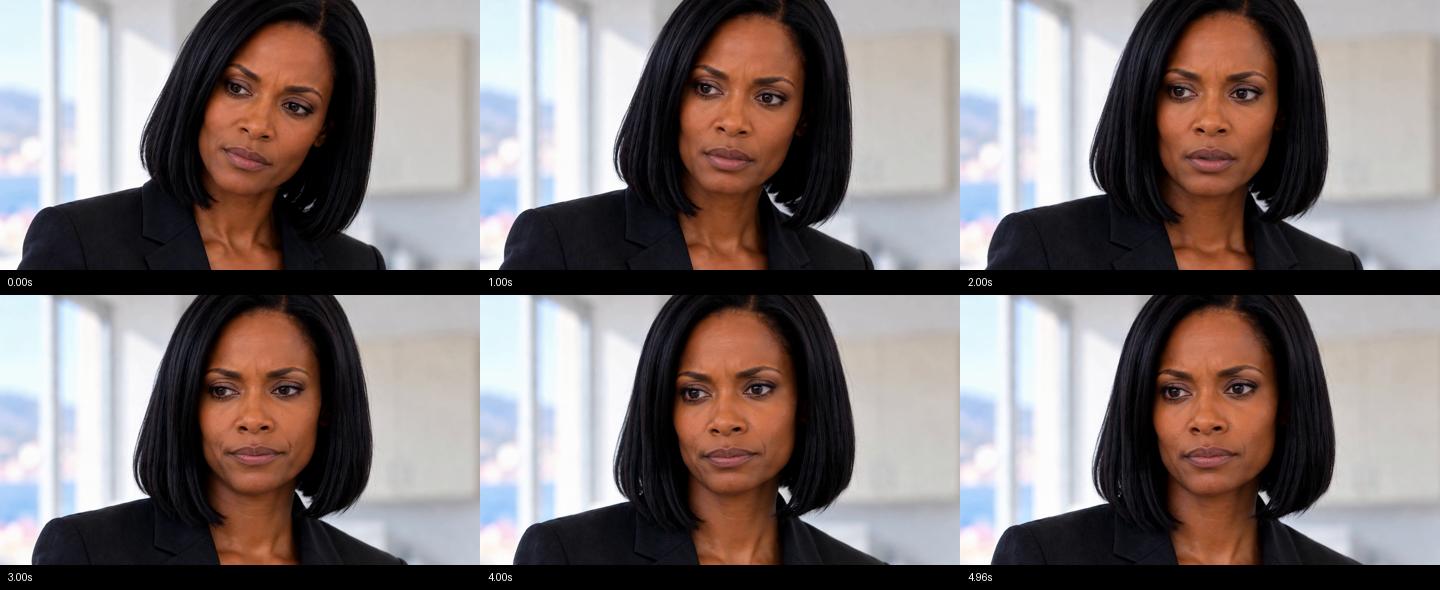
The saved public snapshot contains 43 completed clips: 21 H3, 17 LTX and 5 Wan. Twenty-eight entries use the Nina close-up; fifteen cover cart boarding, cart departure, a pass, a sedan action and a combined cart sequence. The published selection is a review collection, not every run in the research archive or a complete factorial matrix. It cannot supply an overall failure rate.
The recipes include H3 Base 20, H3 Turbo 4, native eight-step LTX and two-stage LTX 8+3, plus twenty-step Wan. One H3 ten-step pilot is labeled separately. A two-stage recipe combines a smaller first pass with latent upscaling and refinement; its step count is not directly comparable to the same number of native-resolution steps.
Every time in this paper is elapsed time to a finished file, including loading required by the current cache and output processing. Setup and downloads are excluded. These are individual observations, with no repeated-run confidence estimates or standardized cold/warm-cache comparison. The October 29 comparison paper also reports server execution time, which is a different timing boundary.
Five-second clips: what the original computer could do
To avoid blending different scenes into one model ranking, this table uses only the Nina close-up. Times are rounded to the nearest second; the download retains the original precision.
| Nina close-up · 5-second clip | 480p | 720p | 1080p |
|---|---|---|---|
| H3 Base 20 | 3m 34s | 13m 04s | 53m 51s |
| H3 Turbo 4 | 1m 02s | 3m 03s | 11m 53s |
| LTX native 8 | 0m 52s | 1m 08s | 3m 15s |
| LTX 8+3 | 0m 31s | 0m 52s | 3m 25s |
| Wan 20 | 2m 27s | 7m 14s | 24m 10s |
The fastest Nina five-second observation was LTX 8+3 at 480p, at 31.4 seconds to the finished file. At 720p, it took 52.5 seconds, native LTX took 67.6 seconds, and H3 Turbo took 183.1 seconds. Those waits suggest very different rhythms for trying a composition or camera action.

There is an important exception to any simple “8+3 is always faster” story: at 1080p for five seconds, native LTX finished in 3m 15s, while 8+3 took 3m 25s. Cache and processing conditions were not isolated, so this pair establishes what happened in those runs, not why.
The separately labeled H3 ten-step 1080p pilot took 28m 09s in this gallery snapshot. It must not be substituted for the twenty-step result of 53m 51s. The fact that both produce five seconds of video does not make them the same generation recipe.
Ten-second clips made the limits clearer
| Nina close-up · 10-second clip | 480p | 720p | 1080p |
|---|---|---|---|
| H3 Base 20 | 9m 40s | 40m 52s | No completed entry |
| H3 Turbo 4 | 2m 29s | 8m 52s | GPU out of memory |
| LTX native 8 | 1m 13s | 2m 55s | 40m 22s |
| LTX 8+3 | 0m 48s | 1m 45s | 6m 12s |
| Wan 20 | 5m 53s | 19m 53s | No completed entry |
For the Nina ten-second 1080p case, native LTX took 40m 22s to a finished file, while LTX 8+3 took 6m 12s. The longer duration changed the time budget sharply. These figures include file preparation; the corresponding server-only times cited in the later paper are about 40m 10s and 6m 03s.

The H3 Turbo 4 attempt at 1080p for ten seconds ran out of GPU memory and produced no finished clip. The snapshot records that further H3 1080p/ten-second attempts were omitted by request. The absent Base 20 and Wan entries at that setting are labeled “No completed entry”; absence is neither a zero-second render nor evidence that those recipes failed in the same way.
More than one kind of shot
The gallery also includes movement and detail shots. At 720p for five seconds, LTX 8+3 took 52.9 seconds for boarding, 53.6 seconds for departure, 48.3 seconds for the pass, and 48.8 seconds for the sedan. Corresponding H3 Turbo observations ranged from 2m 53s to 2m 58s.
The combined ten-second cart sequence took 1m 51s with LTX 8+3 at 720p, compared with 8m 46s for H3 Turbo at that resolution. These are distinct shot packets; combining their times with Nina would conceal that change in content. The downloadable data identify scene, recipe, duration, resolution, seed and exact clip ID for every entry.
How to read the original gallery
Open the October 25 clip-review gallery and filter by scene, model, resolution or duration. It is a fixed snapshot, not a live queue. Use the filters to keep the scene and output length consistent before comparing recipes. The download controls preserve access to individual takes.
The snapshot explicitly marks visual quality as pending. Completed media and shorter waits do not prove that a shot is creatively approved, that dialogue matches, or that a full episode can be produced at that rate. This was a hardware-and-workflow exploration. The next production question is how much of the generated material survives into a finished edit.
Where this fits in the research
This original configuration could generate local footage, including some 1080p results. It also exposed substantial waits and at least one documented memory failure. That is the baseline against which later work should be read—not a claim that the old machine could do nothing.
The October 29 hardware paper compares 18 matched old/new pairs and reports the upgraded 1080p and 2K matrix. Its matched subset is not identical to this curated 43-clip gallery. The cost and studio-capacity paper then asks what ownership, rental and APIs might mean for a goal of five to ten finalized short episodes per day.
Sources and preserved data
- Original interactive gallery, with its October 25, 2026, 11:36 PM EDT snapshot label.
- Preserved 43-entry JSON snapshot and readable CSV, including exact file-ready times and links to the original clip URLs.
- Source and adaptation notes. The narrative and figures use the saved local gallery files associated with the same Sites project. The Sites connector confirmed the active public gallery and version 3; an unauthenticated live data fetch returned 403, so live-versus-saved JSON byte equality was not verified.
Research dated October 25, 2026; archival write-up prepared October 29 with AI assistance and Elizabeth Ann West directing publication. Original clips, measurements and gallery remain preserved.